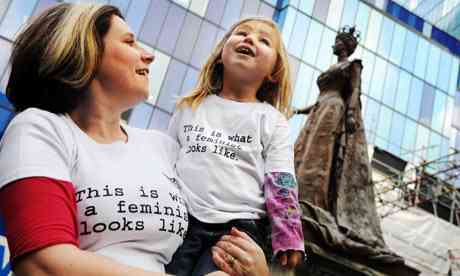
Viv Groskop and her daughter Vera, subsequent to a statue of Queen Alexandra in London. Photograph: Linda Nylind
Despite my majority appropriate efforts, my three-year-old daughter Vera hasn"t usually been celebrating her girlhood of late. In fact, shabby by her six-year-old brother, she can often be listened muttering, "Girls are boring. I wish to do boys" things." I can see her point. Her brother"s hold up is full of Star Wars, pirates, football and alternative action-packed phenomena. Vera gets Hello Kitty. She obviously finds this unsatisfying, and the incident is opening to a head. "I am not a girl, Mummy, I am a boy," she told me recently. "My name is Peter."
But it"s good to be a girl, I discuss it her. Being a lady is fun. There are women"s successes to be celebrated. There is happiness in the womanlike condition. How can I infer this though? In the home city, London, there is usually not that majority earthy justification of women"s greatness. The Alison Lapper statue in Trafalgar Square was taken down in 2007. There are 9 masculine statues in Parliament Square – and no womanlike ones. London"s initial open statue of a black woman, Bronze Woman by Aleix Barbat, in Stockwell Memorial Garden, did not crop up until 2008. Germaine Greer has often complained that women are underrepresented in open monuments, observant that one of the usually new sculptures of a lady is of the actress Diana Dors at the Shaw Ridge camp formidable in Swindon. Now, I similar to Diana Dors. But this is pathetic.
I was not about to frogmarch Vera to Swindon, but I desired the thought of an adventure, exploring women"s dark impress on the streets. So I motionless it was time for her initial feminist pilgrimage. My mother-in-law reeled: "That bad child." But I knew how to sell it to Vera. "Would you similar to to come and find out what lots of critical ladies did, and afterwards we"ll have cake?" "Yes," she replied seriously. "I would similar to cake."
Rachel Kolsky, a London traveller guide, has run women"s on feet tours given 2005. "They open people"s eyes to the dark story of an area," she says. "There is a good women"s story on each corner." Vera and I set off on a three-hour transport around the East End of London, starting at the Royal London Hospital, the focal point of the Wonderful Women of Whitechapel and Spitalfields Tour. Here, Kolsky tells a story about Eva Luckes, the important sanatorium matron, whose successes enclosed the containment of a typhoid epidemic. The hospital"s middle yard has a pretentious statue of Queen Alexandra, who was instrumental in bringing a new diagnosis for illness to the hospital. "Look at that strong, unapproachable lady, Vera!" I say. "You pronounced I could have cake," she says. "I"m cold."
Then Vera starts to cry, bringing the journey to a remarkable end. This is the complaint with Kolsky"s shining London tours: in sequence to showcase women"s buried history, they cover a lot of ground. Great for an adult, but somewhat as well desirous for a three-year-old.
I am not deterred though. Quite the opposite. As we head home I am hatching plans for destiny feminist pilgrimages. In the UK, we can follow in the footsteps of Virginia Woolf, Jane Austen, and the Brontës. Or, subsequent time we are flitting the Houses of Parliament, we could check out the statue of Emmeline Pankhurst, one of London"s couple of womanlike landmarks, in Victoria Gardens. Then there"s a route of Pankhurst family blue plaques to be followed in London, from 50 Clarendon Road in Holland Park to 120 Cheyne Walk in Kensington.
Further afield there is Gertrude Stein"s unit in Paris at twenty-seven Rue de Fleurus. Now a in isolation home, this residence was once host to weekly salons and packaged with paintings by Renoir, Gauguin and Cézanne; Picasso was a unchanging cooking guest. You competence usually be means to transport past these days, but you can still remember fondly on key passages in Stein"s classical work The Auto- autobiography of Alice B Toklas. Or, in the same city, you could revisit Simone de Beauvoir"s grave – subsequent to Sartre"s – at the Cimetière du Montparnasse.
In New York there is a extensive Dorothy Parker route heading from the Ansonia at 2108 Broadway (one of New York"s majority important unit blocks: Parker lived around the corner), to the 1925 hearth of the New Yorker repository at West 47th Street, where Parker worked, and on for cocktails at the Algonquin Hotel. Then there are all the good feminist museums: the Elizabeth A Sackler Center for Feminist Art, for instance, at the Brooklyn Museum in New York, that includes a art studio clinging to Judy Chicago"s "vaginas on plates" sculpture, The Dinner Party.
Maybe I will even begin a "Sylvia Plath does New York" account for when Vera turns 16. We will stay at the Barbizon Hotel at 63rd and Lexington – that was once women-only – wearing dresses with relating bags, as Plath did. We"ll lunch nearby the one-time offices of Mademoiselle at 575 Madison Avenue where Plath was an intern. Or we"ll criss-cross Massachusetts in a bluish 1966 Thunderbird Convertible à la Thelma and Louise in honour of Louisa May Alcott, scruffy copies of my prime childhood book, Little Women, in tow. More expected though, we competence usually go to Stockwell when the continue warms up and take a see at that Bronze Woman, holding her baby triumphantly aloft. As prolonged as there"s an ice-cream outpost nearby, I"m certain Vera will be up for it.
For any one who wants to try women"s lives and history, here are a small alternative good ideas for feminist pilgrimages.
Bath: Jane Austen
Austen lived in Bath from 1801 to 1806. The Jane Austen Centre at 40 Gay Street is gearing up for September"s Austen Festival that facilities "the event to skirt via the week in 18th-century Regency costume". You can have "tea with Mr Darcy" (a £10.50 high tea with cucumber sandwiches, scones and cream) all year round. Those penetrating for an Elizabeth Bennett-style inherent can download a free audio on feet debate "In the footsteps of Jane Austen" at visitbath.co.uk. There is additionally a "Jane for the day" referred to timetable: "12.45pm: Visit the Assembly Rooms: in Jane"s day, guest fabricated for balls, to splash tea, fool around cards, attend to song or usually to speak and flirt. 3pm: Stroll around the streets Jane would have known."
Sussex: Virginia Woolf
"It is not so majority a residence as a phenomenon." So wrote Quentin Bell of Charleston, the nation home in in between Eastbourne and Lewes that was used by the writers, artists and thinkers well well known as the Bloomsbury organisation in the early 20th century. Virginia and Leonard Woolf creatively speckled this late-17th-century Sussex farmhouse, situated at the feet of the South Downs, and coaxed Virginia"s sister, Vanessa Bell, to move there in 1916. It reopens for the summer on 31 March, with special tours on Fridays.
The Woolfs" own nation home was Monk"s House nearby Lewes, East Sussex (nationaltrust.org.uk). This skill is assigned by tenants so is open usually for short visits on Wednesday and Saturday afternoons in in between Apr and October. But there is the preferred event on Saturday twenty-six June: an eight-mile transport "In the Footsteps of Virginia Woolf", from Monk"s House to Charleston, with lunch at internal noble home Firle Place (£25). To book tickets, call Charleston on 01323 811626 (charleston.org.uk).
Washington: Michelle Obama
The Smithsonian"s National Museum of American History (on the National Mall, 14th Street and Constitution Avenue) has hundreds of exhibits commemorating the women"s remodel movement. The museum"s First Ladies" Collection celebrates the change of presidents" wives and has been one of the majority renouned exhibitions for the last 100 years, together with repository material, diaries, memorabilia and costumes. This week, the white sheer Jason Wu robe Michelle Obama wore to the initial balls went on show for the initial time.
For an additional reverence to Obama, head to her prime takeout joint, Good Stuff Eatery at 303 Pennsylvania Avenue SE in Washington DC for a "Prez Obama" burger or to Ben"s Chilli Bowl at 1213 U Street NW for the Obamas" prime half-smoke chilli dog. Nearby Busboys and Poets (2021 14th Street), a cafeteria and bookshop, hosts feminist events and has a outrageous feminist book collection.
Amsterdam: Anne Frank
"Now the Secret Annexe has indeed turn tip . . . Mr Kugler thought it would be improved to have a bookcase built in front of the opening to the stealing place. It swings out on the hinges and opens similar to a door." The waterway residence at 163 Prinsengracht was the stealing place of the immature Jewish lady Anne Frank and her family during the Nazi function of Amsterdam, and there are countless tours of the city that embody the house, where you can revisit the annexe where Frank wrote her tip diary. The residence opens at 9am, and it is majority appropriate to revisit early to equivocate queues (annefrank.org).
Paris: Simone de Beauvoir
As the French transport bible Guide du Routard notes, "In the winter Simone de Beauvoir came regularly initial thing in the sunrise to the [Café] Flore to have a chair nearby the stove. Sartre recreated the ambience of an English club. Everybody listened to jazz, review poems or played small acts." Pay loyalty to the good feminist reflective thinker over a café au lait at Café Flore, prior to downloading a on feet debate from St Germain to the Louvre at girlsguidetoparis.com for $1.98 (£1.30). This takes in 60 Rue de Seine where de Beauvoir once lived, and whilst you are strolling, remember: one is not innate a woman, one becomes one.
• Wonderful Women of Whitechapel and Spitalfields starts at 11am on thirteen March. Tickets can be requisitioned by the Women"s Library on 020-7320 2222. Battling Belles of Bow, 11am on Saturday 5 June, follows in the footsteps of Sylvia Pankhurst. For some-more report on alternative tours, email rachel@smallcake.co.uk or revisit goeastlondon.co.uk

No comments:
Post a Comment